Around the year 1990, I saw a video documentary on the wrecks of Truk Lagoon. Being only 10, it blew my mind and left me with long lasting intrigue. Truk is a protected lagoon in the South Pacific that the Japanese used to protect many ships during World War 2. The U.S., on February 17-18 of 1944, planned an aerial attack that would decimate the harbored ships. Many vessels lie in 20-200ft of water today and are in wonderful condition entombed in warm (84 degree Fahrenheit,) clear water. After getting into diving in 2009, I always thought that maybe someday I would make the pilgrimage to what many consider the wreck diving capital of the world. Well, it happened, and what we experienced was much more than a pile of machinery laying on the ocean floor. The sea life, history, stories, friends, and of course food, made for an exceptional adventure. Here is my take on it all.

When talking about diving Truk Lagoon, other divers always ask, "So you are going on a live-a-board, right?" Katherine did a bunch of research and while a live-a-board would be nice, they are just not something we can afford with the frequency we travel. Besides, the land based operations also have their perks. There are only two options for land based diving on Chuuk, the Truk Stop Hotel and Blue Lagoon Dive Resort. Both operations get similar reviews, and we probably would have been happy with either. Truk Stop is in the center of the small downtown area, so a short ride to and from the airport if rough roads bother you. Although Blue Lagoon is only a couple miles from the airport, the drive takes about 30 minutes due to the poor condition of the road. We decided to go with Blue Lagoon Dive Resort because we heard the grounds were prettier and more extensive. The Blue Lagoon Dive Resort is on the southern tip of Weno island, providing close proximity to many of the wrecks. Our boat rides were no more than a half hour, usually less, and the accommodations were simple and clean, just what we needed. Plus, for every dive but 2, Michael, Katherine, and I had the boat to ourselves. We felt very spoiled.

This Japanese bunker was right on the resort property!
The diving was mind blowing. Over the 16 dives we did during the week, we visited 15 different wreck sites! Below I have added some of our best photos. It would be crazy to outline what we saw on each wreck. I detailed that in the dive log books.

On our first dive, we went right into a hold with TONS of ammunition laying everywhere.

Huge artillery shells

Katherine by one of the massive aircraft engines.

Betty Bomber's navigation hatch.

Michael and Katherine inspecting the bomber.
We all looked forward to dinner each night. The menu was extensive, offering local dishes, as well as Japanese and international fare. The local caught fish and sides were tasty and served in huge portions. In particular, the sashimi was delectable, and only $6 for a full plate! At the resort, you are held captive for food, but the prices in the restaurant are reasonable ($8-$15 US,) especially considering where you are on the planet. I was impressed with what they could whip up given the circumstances. We never ate lunch in the restaurant because breakfast was so huge, and we didn't have time for it coming back after the morning's first two dives. We would just have a little snack back in the room, jot down our log book info and head back out for the third dive of the day after a bit of rest.

A ship's compass with the glass destroyed.

The artwork on the china is just as clear as the day it was painted. Binoculars as well.

The visibility on the decks was outstanding!

Michael exiting a through a window.

Check out the deck ladder with our guide Joe.

Engine room.

Katherine and Joe in the engine room.
From reading other diver's posts, I knew that we had the possibility of seeing human remains on these wrecks. In fact, Truk is a true graveyard and a time capsule of an era which seems surreal to me. I had seen MANY World War 2 videos from airplane dogfights and field soldiers, but it all becomes reality when you see these relics right in front of you.
Something very strange happened to me in one of the engine rooms. While seeing bones, bottles, ammunition, and personal effects make the experience hair-raising real, the ships have another way of showing you they are alive. It's the oil. Yes, oil is still slowly leaking out of the various machines on the ships and leave streaks in the water. Since the inner holds and rooms of the ships prevent micro currents, at times you will see lined streaks in the water. It's very faint, but once I figured out what this was, I was sure that the ships themselves were still bleeding out from the destruction of war. I was fixated on a certain streak, and while focused with my eyes, and being totally silent with my regulator, I listened. What I heard was surely shifting metal plates, but in the moment it kind of sounded like the ship's death moan. Tied together with what I saw in the water, it was beyond eerie.

Femur, bottles, and aircraft oxygen hose.

Katherine and her assistant.

Light fixture still hanging.

Heian Maru
On the Heian Maru, we had a group of 4 Japanese divers join us for their first dive in the area. The ship is in shallow water and the name is perfectly legible in plenty of natural sunlight. While I was taking pictures and swimming about, I noticed one of the divers bowing and saying a prayer. I thought this was a special moment where previously there had been war and destruction between two countries, and here we are visiting war graves paying our respect. Later at dinner, we spoke of our dives and enjoyed the beach together, in stark contrast to what the encounter would have been like 73 years ago.

Ship's helm with wheel and telegraph still intact.


Exploring a hold. Dangling heavy metal plate = possible guillotine. Not advisable.

Little guy on the coral! Look closely.

On many days, our surface interval was on Eten Island. During the war, this exact location was a landing strip for airplanes.


Michael on the deck.
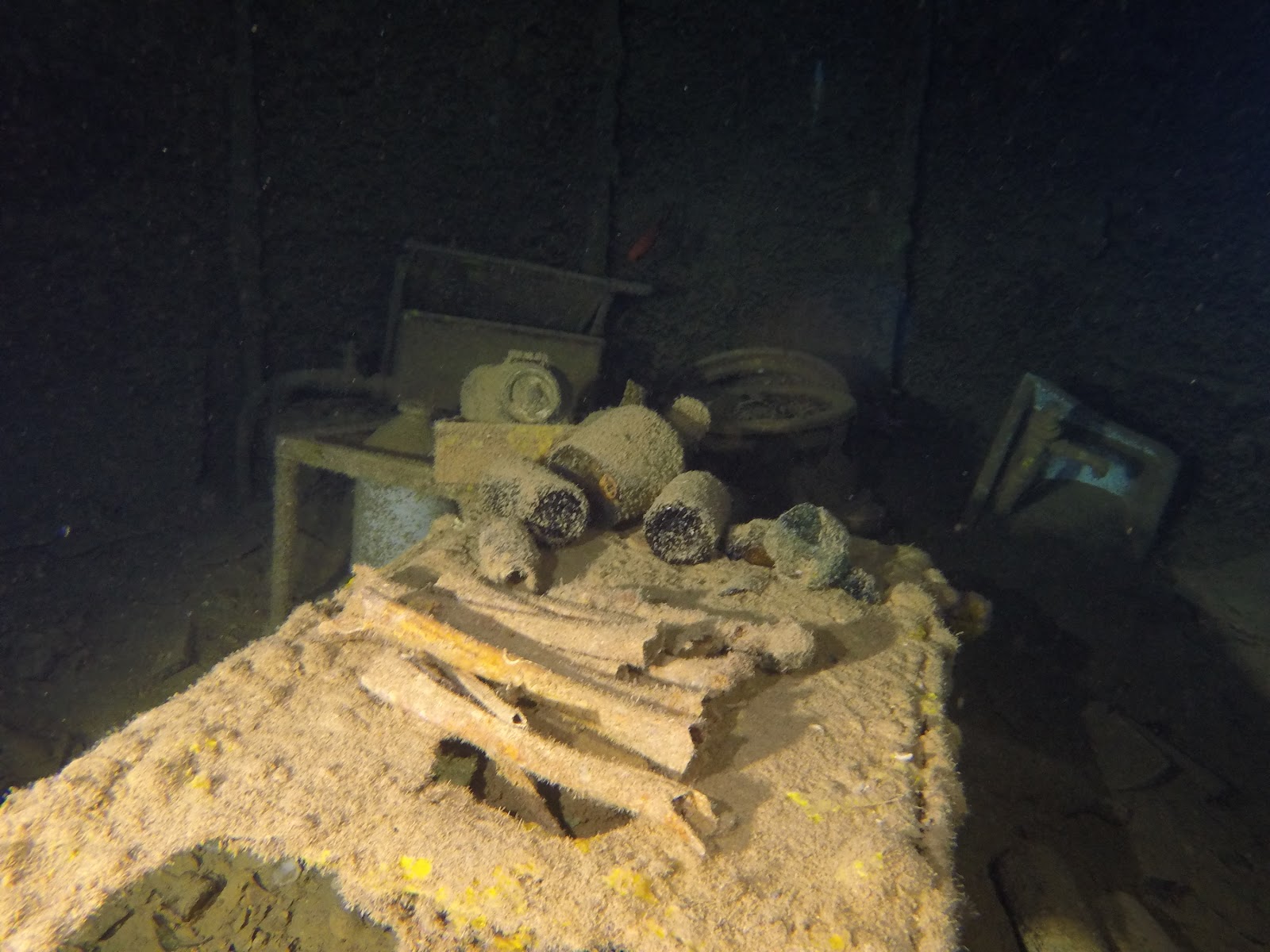
Operating room table.

I kept this shot even though it's blurry since the passageway was so cool. The ship was a submarine tender with periscope tubes laying on the floor.

The size of the ships is really put into perspective when you see the "screws" or propellers.


As we off-gassed on our last day we took a land tour of Weno Island. Pictured above is the Jesuit school, Xavier High School , which during the war was a fortified communications center. It was thought to be "bomb proof," but a US bomb went right through and destroyed a large section. It was repaired and is now a school.

Look closely at the rule infractions. My students at school thought it was impressive.

A purple shrimp party.


Soft coral was EVERYWHERE!

Katherine checking her tanks.

A tank on the deck of the Nippo Maru.

Torpedo

Torpedo

Previous local politician's house. Recently, burned down.

A ground mounted canon built into the side of the mountain. Since the raid was an aerial attack, this was not used.

Typewriter

Japanese Zeros in the Fujikawa Maru


Last night BBQ with Stenson and Joe.

Stenson manning the grill.

Katherine and Joe
To make the Truk and Palau trip happen, we had been collecting airline miles through United Airlines for several years. Paying straight up for these tickets would have been insane! Once there, the diving costs were about the same as everywhere, at around $80 per dive. But getting there and back entailed 10 different flight legs, and on the way there it was close to 40 hours of travel time. Being back in the USA and writing up this post, it was TOTALLY worth it. I would like to get back sometime, but with more friends to share the experience.


